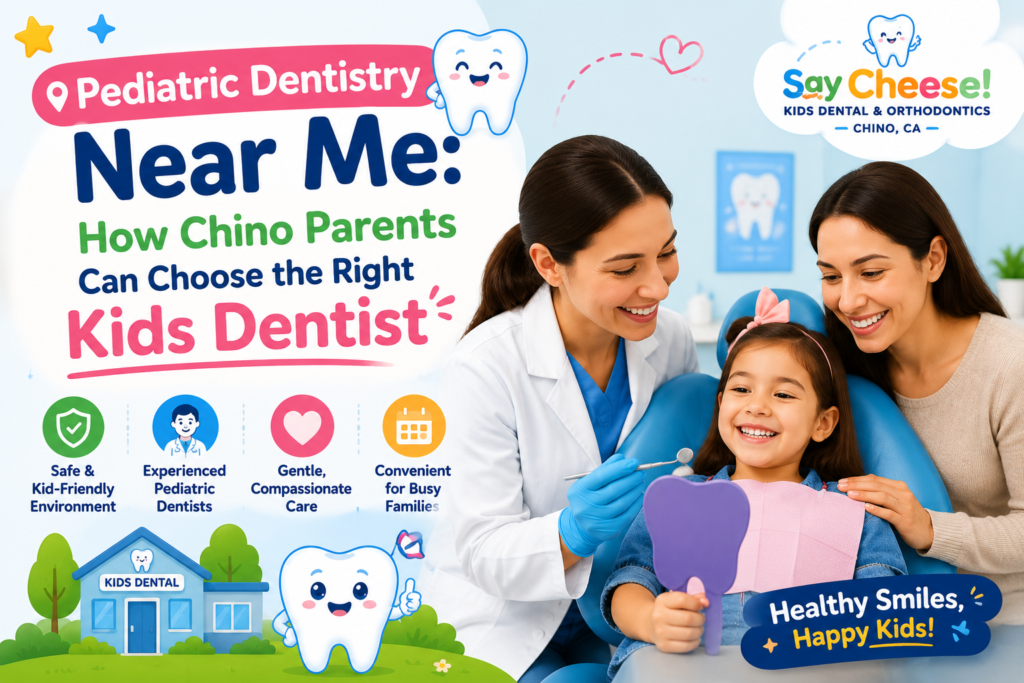
Quick Answer: Pediatric dentistry is a dental specialty focused on infants, children, and teens. When searching for pediatric dentistry near me in Chino, CA, look for a dentist with completed pediatric residency training, a child-focused office, sedation options for anxious kids, same-day emergency availability, and insurance plans that match yours. The American Academy of Pediatric Dentistry recommends a first visit by age one.
Introduction
Typing “pediatric dentistry near me” into your phone usually happens for one of two reasons. Either your child just turned one and you know it’s time, or something has gone wrong — a toothache at bedtime, a chipped tooth on the playground, a cavity your family dentist spotted and referred out.
Either way, the search results look the same: a map with pins, star ratings, and a dozen offices that all describe themselves as gentle and kid-friendly. Distance and reviews are a starting point, but they don’t tell you much about whether a particular office is a good fit for your child.
This guide walks through what pediatric dentistry actually involves, what separates a pediatric dentist from a general dentist, and the specific things Chino and Chino Hills parents should look for before making that first appointment.
What Pediatric Dentistry Actually Means
Pediatric dentistry is a recognized dental specialty devoted to the oral health of children from infancy through the teenage years. It covers preventive care, cavity treatment, growth and bite monitoring, dental emergencies, and behavior guidance for children who are nervous about treatment.
The specialty exists because children’s mouths are not small adult mouths. Baby teeth have thinner enamel and larger nerve chambers, which means decay can move faster and reach the nerve sooner. Jaws are still growing. And a four-year-old’s ability to sit still, understand instructions, and cope with an unfamiliar environment is entirely different from an adult’s.
How pediatric training differs from general dentistry
After dental school, a pediatric dentist completes additional residency training focused specifically on children. That training typically covers:
- Child growth and development, including how teeth and jaws change over time
- Behavior guidance techniques for young, anxious, or uncooperative patients
- Treating children with special healthcare needs
- Pediatric-specific procedures such as pulp therapy, stainless steel and zirconia crowns, and space maintenance
- Age-appropriate sedation and safety monitoring
- Dental trauma management in growing children
A skilled general dentist can absolutely care for children. The difference is that a pediatric practice does this all day, every day, with equipment, staff, and an environment built around it.
Why “Near Me” Is a Good Starting Point — But Not the Whole Answer
Proximity matters more than parents expect. A dental home isn’t a one-time visit — it’s checkups every six months, the occasional filling, an orthodontic evaluation around age seven, and a phone call the evening your child falls off a scooter.
An office fifteen minutes away that you can reach after school beats an office forty minutes away with slightly better reviews. Families in Chino, Chino Hills, Eastvale, and Ontario often find that a short drive is the single biggest factor in whether they actually keep up with routine visits.
That said, distance alone shouldn’t decide it. The checklist below covers what to weigh alongside location.
A Parent’s Checklist for Choosing a Kids Dentist in Chino
1. Confirm the training, not just the wording
Any office can call itself family-friendly. Look for a stated pediatric focus, the dentist’s education, and how many years they’ve been treating children specifically. Most practices list this on their About or Meet the Doctor page.
2. Ask how they handle a nervous child
This is the question that separates offices. Good answers involve showing the child the instruments first, explaining steps in simple language, and letting a hesitant child ease in over more than one visit. If the answer is only “we have TVs,” keep asking.
For children whose anxiety runs deeper, or for longer procedures, ask whether the practice offers nitrous oxide or other age-appropriate options. Sedation dentistry for kids is not something every child needs, but knowing it’s available prevents a difficult appointment from becoming a lasting fear.
3. Check what’s available under one roof
Being referred elsewhere for every crown, extraction, or orthodontic question means more time off work and more explaining to a child who has just gotten comfortable. Ask whether the practice handles:
- Routine exams, cleanings, and digital X-rays
- Fluoride treatments, sealants, and silver diamine fluoride
- Fillings, pediatric crowns, pulp therapy, and extractions
- Space maintainers after early tooth loss
- Early orthodontic evaluation, braces, and clear aligners for teens
4. Ask about emergency availability
Dental injuries rarely happen during business hours. Find out before you need to know whether the office reserves same-day slots and whether there’s a way to reach someone after hours. A practice that offers emergency kids dental care in Chino can save you a long night and, in the case of a knocked-out permanent tooth, can meaningfully affect the outcome.
5. Verify insurance before the first visit
Call and confirm your specific plan rather than relying on a website list. Ask whether the office accepts Medi-Cal (Denti-Cal) if that applies to your family, which PPO plans they’re in-network with, and whether financing is available for treatment insurance doesn’t fully cover.
6. Consider the scheduling reality
If you have three kids, can they be seen back-to-back or in the same block? Are there appointments that don’t require pulling a child out of a full school day? These logistics decide whether checkups actually happen twice a year.
7. Read reviews for patterns, not perfection
One frustrated review means little. Repeated comments about the same thing — long waits, rushed exams, or conversely, patience with a difficult child — tell you something real. Parents also frequently mention whether a dentist over-recommends treatment, which is worth paying attention to.
When Should Your Child First Be Seen?
The American Academy of Pediatric Dentistry recommends a first dental visit by the child’s first birthday, or within six months of the first tooth appearing — whichever comes first.
That surprises many parents, since a one-year-old may only have a few teeth. But the purpose of that visit isn’t a deep cleaning. It’s to check for early decay, review feeding and bottle habits, demonstrate how to brush tiny teeth, and give the child a low-pressure introduction to the office.
A rough timeline most families follow:
- By age 1: First visit and establishment of a dental home
- Ages 2–5: Checkups every six months, fluoride, and habit guidance
- Around age 6: First permanent molars arrive — a common time for sealants
- By age 7: First orthodontic evaluation to assess bite and spacing
- Ages 8–13: Monitoring as baby teeth give way to permanent ones
- Teen years: Wisdom tooth monitoring, sports mouthguards, and orthodontic follow-up
What Happens at a First Appointment
Knowing the sequence helps you prepare your child honestly, which matters more than any distraction technique. A typical first visit runs like this:
- The team greets your child and gives them a moment to look around
- A gentle exam checks teeth, gums, bite, and soft tissues
- A cleaning removes plaque and polishes the teeth, if the child is comfortable
- X-rays are taken only when clinically necessary
- Fluoride may be applied to strengthen enamel
- The dentist reviews findings with you and answers questions
Ongoing kids dental exams and cleanings follow the same rhythm, which is exactly why the first one is kept short and positive. Familiarity is what makes future visits easy.
One small tip: avoid words like “shot,” “hurt,” or “drill” beforehand, even in reassurance. Children latch onto them. Let the dental team introduce their own gentle vocabulary.
Prevention Is Where Most of the Value Sits
The bulk of pediatric dentistry is not fixing problems — it’s keeping them from starting. Preventive dentistry for kids typically includes fluoride varnish, sealants on cavity-prone molars, dietary guidance, and brushing coaching that changes as a child’s coordination develops.
At home, the fundamentals are simple and worth repeating: brush twice daily with fluoride toothpaste, floss once teeth begin touching, limit sipping on juice and sweetened drinks throughout the day, and supervise or assist with brushing until roughly age seven or eight, when a child’s motor skills catch up to the task.
Common Myths About Pediatric Dental Care
Myth: Baby teeth don’t matter because they fall out anyway.
Fact: Baby teeth guide permanent teeth into position, support chewing and speech, and can develop painful infections. Losing one too early can crowd the permanent tooth behind it.
Myth: You should wait until all baby teeth are gone before seeing an orthodontist.
Fact: An evaluation around age seven lets a dentist spot crowding, crossbites, or jaw growth concerns while they’re easiest to guide.
Myth: Cavities in children are always caused by candy.
Fact: Frequency matters more than quantity. Constant sipping of juice or milk, sticky crackers, and prolonged bottle use at night all contribute.
Myth: If a child isn’t complaining, nothing is wrong.
Fact: Early decay is usually painless. By the time a child reports pain, the cavity has often reached deeper tissue.
Frequently Asked Questions
What is a pediatric dentist?
A pediatric dentist is a dentist who completed additional residency training focused on treating infants, children, teens, and patients with special healthcare needs.
At what age should my child first see a dentist?
By the first birthday, or within six months of the first tooth erupting — whichever comes first.
How often do children need dental checkups?
Every six months for most children. Some need more frequent visits based on cavity risk, enamel condition, or orthodontic treatment.
Can I stay with my child during the appointment?
In most pediatric offices, yes — particularly for younger children and first visits. Ask about the office’s policy when you schedule.
Are dental X-rays safe for children?
Digital X-rays use very low radiation and are taken only when clinically needed, with protective shielding. Your dentist can explain why a specific image is being recommended.
What should I do if my child knocks out a tooth?
Call the dental office right away. For a permanent tooth, handle it by the crown rather than the root, and keep it in milk if it can’t be gently repositioned. Baby teeth are generally not reinserted — still call for guidance.
Does my child need dental sealants?
Sealants are commonly recommended for permanent molars, which have deep grooves that trap food and are difficult to brush thoroughly.
How do I help a child who is scared of the dentist?
Keep your own language neutral and positive, schedule at a time when your child is rested, and choose a practice experienced with anxious children. Nitrous oxide is available in many offices when extra support is needed.
Do pediatric dentists accept Medi-Cal or Denti-Cal?
Some do and some don’t. Confirm directly with the office, since network participation changes.
When should my child stop seeing a pediatric dentist?
Many practices care for patients through the late teens and the transition to a general dentist. There’s no strict cutoff.
What if my child loses a baby tooth too early?
A space maintainer may be recommended to hold the gap open so the permanent tooth can come in correctly.
Final Thoughts
Searching “pediatric dentistry near me” is really a search for a place your child won’t dread going back to. The office that fits your family is usually the one that’s close enough to visit twice a year without a production, patient enough to earn a shy child’s trust, and equipped to handle both a routine cleaning and an unexpected chipped tooth.
If you’re weighing options in Chino or the surrounding communities, a first consultation is a low-pressure way to see how your child responds to the environment and the team. If you have questions about your child’s smile, a pediatric dental evaluation can help — you can request an appointment whenever you’re ready.
Medically reviewed by Dr. Joshua Kohan, DMD, pediatric dentist in Chino, CA.
