Medically reviewed by Dr. Joshua Kohan, DMD — pediatric dentist, Say Cheese Kids Dental & Orthodontics, Chino, CA
Quick Answer
Baby teeth are temporary, but the job they do is not. They hold space for permanent teeth, support chewing and nutrition, help children form sounds and speak clearly, and set up the habits that protect teeth for life. An infected or prematurely lost baby tooth can affect the permanent tooth developing underneath, which is why decay in baby teeth is treated rather than ignored.
“They’re Just Going to Fall Out Anyway”
This is the single most common thing parents say to us, and it is completely understandable. If a tooth is temporary, why treat it?
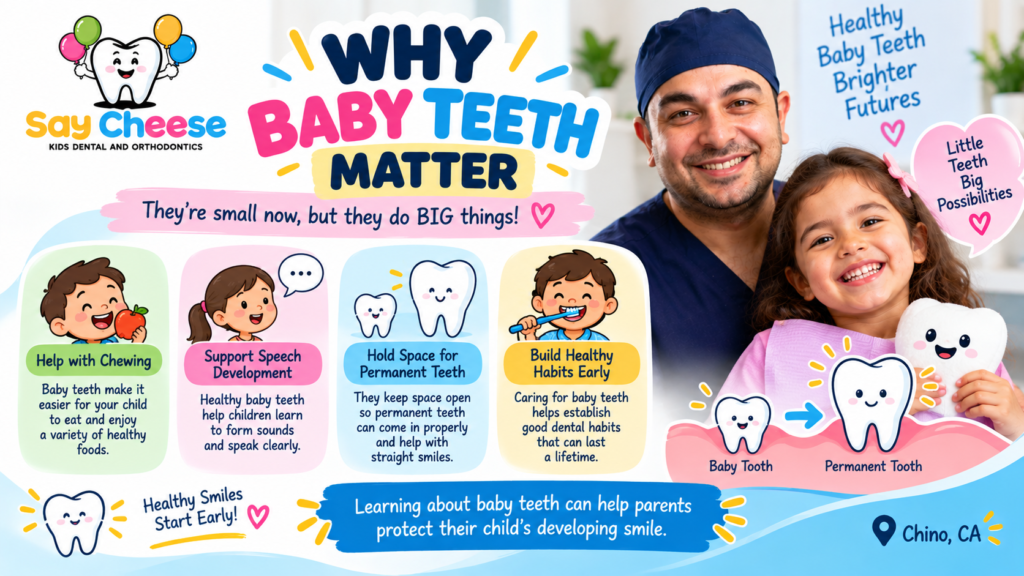
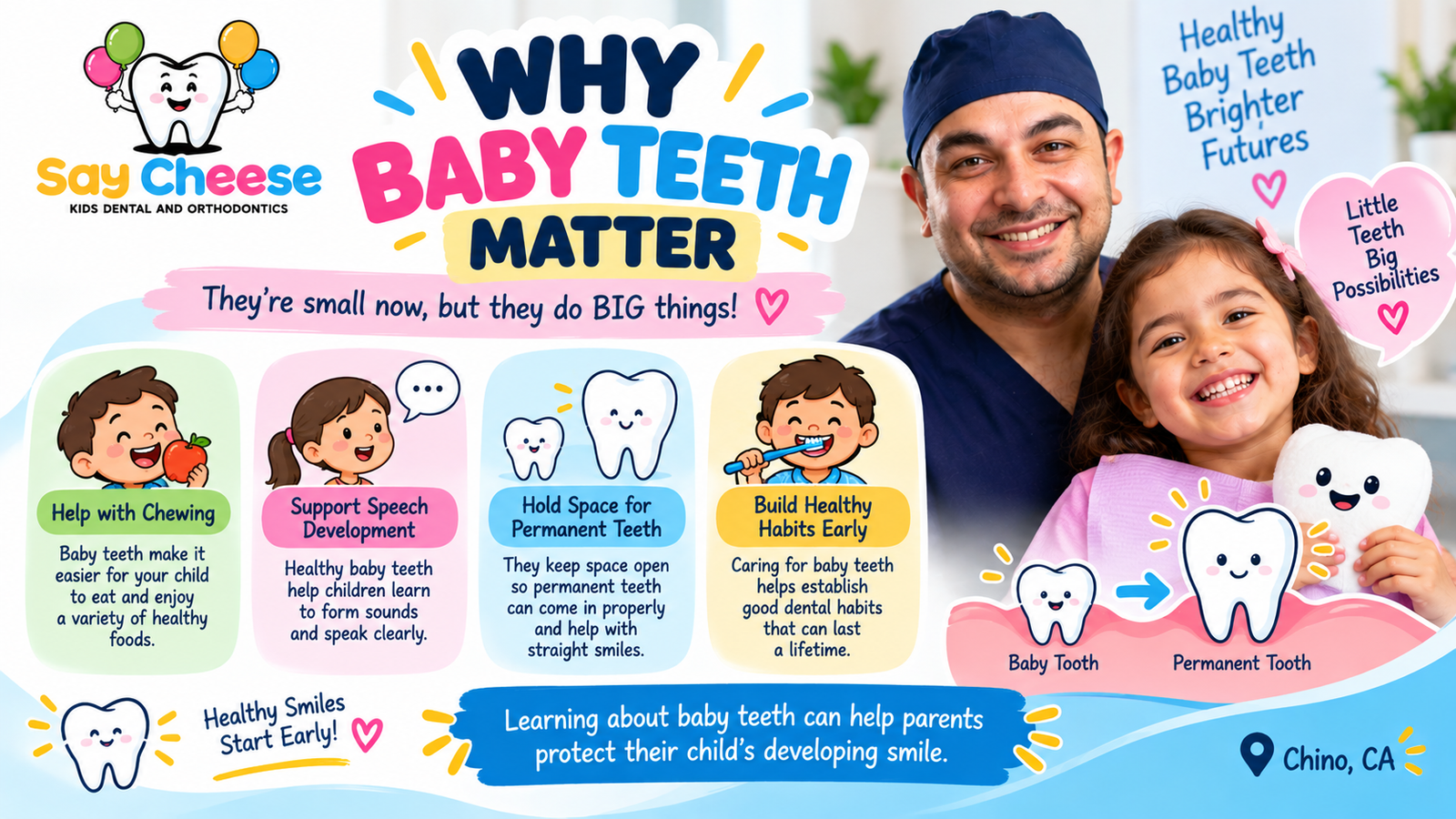
The answer is that baby teeth are not simply placeholders waiting to be discarded. They are doing four jobs at once, and each of them matters for the permanent teeth that follow.
Four Things Baby Teeth Are Doing Right Now
1. Holding space for permanent teeth
This is the big one. Each baby tooth reserves the exact space its permanent successor needs. Lose a baby molar early and the teeth either side drift into the gap within months. The permanent tooth then has nowhere to come through, and arrives crowded, rotated or blocked entirely.
That is why a space maintainer is often recommended after an early loss. It is a small appliance doing the job the tooth was doing.
2. Making chewing possible
Children with painful or missing back teeth avoid chewing on that side, and often avoid harder foods altogether. Diet narrows toward soft, processed options at exactly the age when nutrition matters for growth.
3. Supporting speech development
Front teeth are involved in forming several sounds — think of f, v, th and s. Losing them well before the natural time can affect how a child learns to produce those sounds while speech is still developing.
4. Building habits that stick
A child who learns brushing, flossing and regular dental visits around baby teeth carries those habits into adulthood. A child whose first dental experience is an emergency extraction learns something quite different.
What Happens When a Baby Tooth Is Left Untreated
Decay in a baby tooth does not stay contained. Baby tooth enamel is thinner than adult enamel, so decay reaches the nerve faster — sometimes within months rather than years.
- Pain and infection — often at night, and often the first sign parents notice
- Damage to the permanent tooth — an abscess at the root of a baby tooth sits directly above the developing permanent tooth and can leave lasting enamel defects
- Early tooth loss — leading to crowding and possible orthodontic treatment later
- Missed school and disrupted sleep — dental pain is one of the more common causes of both
None of this is inevitable. It is what happens when early decay is left because the tooth was assumed not to matter.
When Baby Teeth Come In — and When They Leave
- 6 to 12 months — first teeth appear, usually the lower front two
- By around age 3 — all 20 baby teeth are usually present
- Around age 6 — the first permanent molars arrive at the back, and the lower front baby teeth start to loosen
- Ages 6 to 12 — baby teeth are gradually replaced
- Around 12 to 13 — most children have their full permanent set apart from wisdom teeth
The back baby molars are often the last to go, sometimes staying until age 12. A cavity in one of those at age five has seven years left to cause trouble.
How to Protect Them
- Brush twice daily with fluoride toothpaste — a rice-grain smear under three, pea-sized after
- Start flossing once any two teeth touch
- Limit how often sugary food and drink appear, which matters more than the total amount
- Avoid bottles of milk or juice at bedtime
- Keep six-monthly visits so decay is caught while it is small
- Ask about sealants and fluoride, which do much of the quiet work
Common Questions
Do baby teeth with cavities really need filling?
Usually yes. It depends on how much time the tooth has left and how deep the decay is. A small cavity in a tooth due to fall out in six months may just be watched. The same cavity in a molar that has seven years to go will be treated.
What if my child loses a baby tooth early?
Contact us so we can assess whether the space needs holding. Back teeth lost early often need a space maintainer; front teeth lost near their natural time usually do not.
Can decay in a baby tooth affect the permanent tooth?
Yes. The permanent tooth develops directly beneath the baby tooth. An untreated infection at the root can disturb enamel formation, leaving marks or defects on a tooth that has not erupted yet.
At what age do baby teeth start falling out?
Usually around age six, beginning with the lower front teeth, continuing until about twelve or thirteen. Some variation either way is entirely normal.
Should I pull a loose baby tooth?
Let it come out on its own. Wiggling is fine if your child enjoys it, but forcing a tooth that is not ready can be painful and leave root fragments behind.
My child knocked out a baby tooth — do I put it back?
No. Never reimplant a baby tooth, as it can damage the permanent tooth above. See what to do if a tooth is knocked out.
When should my child first see a dentist?
By age one, or within six months of the first tooth. See when to book a first visit.
Are baby teeth more prone to cavities than adult teeth?
Yes. Their enamel is thinner, so decay progresses more quickly once it starts. That is why six-monthly checks matter more in childhood, not less.
Final Thoughts
Baby teeth are temporary in the sense that they will be replaced. They are not temporary in the sense of unimportant. What happens to them shapes the permanent teeth arriving behind, and the habits a child carries for the next seventy years.
If you are unsure whether something needs treating, call (909) 479-6030 or request an appointment. We will tell you honestly if the answer is to wait and watch.
