
Medically reviewed by Dr. Joshua Kohan, DMD — pediatric dentist, Say Cheese Kids Dental & Orthodontics, Chino, CA
Quick Answer
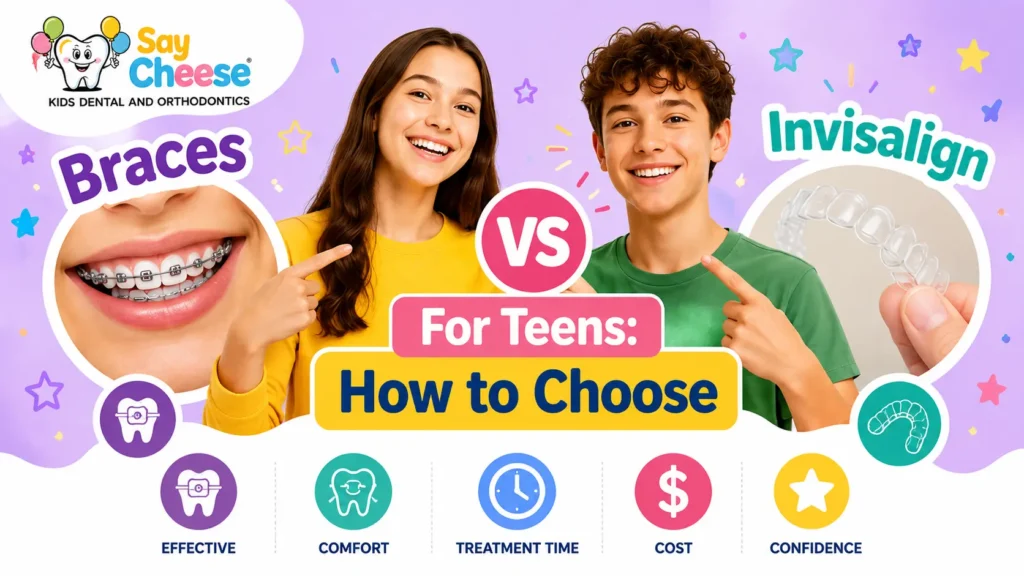
Braces are fixed to the teeth and work whether or not your teen remembers them. Invisalign and clear aligners are removable and nearly invisible, but only work if worn 20 to 22 hours a day. For complex movement, braces are more predictable. For mild to moderate crowding or spacing in a teen who will be consistent, aligners work well. The deciding factor is usually compliance, not the appliance. Consultations at Say Cheese Kids Dental in Chino are free.
The Difference That Actually Matters
Almost every comparison you will read focuses on appearance. That is the least important difference.
Braces are bonded to the teeth and stay there. They apply continuous pressure twenty-four hours a day, without your teen having to do anything. Aligners come out — for meals, for brushing, for a school photo — and every hour they spend out of the mouth is an hour the teeth are not moving.
That single distinction drives most of what follows.
Side by Side
- Appearance — aligners are barely noticeable at conversational distance. Braces are visible, though ceramic brackets are considerably less so than metal.
- Cleaning — aligners come out, so brushing and flossing are normal. Braces need more effort and time around brackets and wires.
- Comfort — aligners cause pressure for a day or two after each new tray. Braces can rub the cheeks for the first fortnight and occasionally have a poking wire.
- Food — no restrictions with aligners since they come out. With braces, no hard sweets, ice, nuts, popcorn or chewy foods.
- Appointments — broadly similar, every four to eight weeks for either.
- Case complexity — braces handle the full range including significant rotations and bite correction. Aligners suit mild to moderate cases.
- Sport and music — aligners come out for contact sport with a mouthguard in. Braces need a mouthguard made to fit over brackets, and wind players need a couple of weeks to adjust.
- Depends on your teen — braces work regardless. Aligners only work if worn.
When Braces Are the Better Choice
- Significant crowding, or cases needing teeth removed to create space
- Bite correction — deep overbites, underbites, and crossbites
- Teeth needing substantial rotation or vertical movement
- A teen who is forgetful, disorganised, or simply not invested in the treatment
That last point is not a criticism of teenagers. It is a realistic assessment, and getting it right saves months. See teen braces for what treatment involves.
When Aligners Are the Better Choice
- Mild to moderate crowding or spacing
- A teen who is motivated, often because the appearance matters to them
- Someone who plays a wind instrument or a contact sport regularly
- A history of difficulty keeping teeth clean, where removable appliances genuinely help
We offer Invisalign and Angel Aligners — see clear aligners for how the trays work.
The Honest Part: Compliance Decides It
Aligners need 20 to 22 hours a day. That is not a target to aim at — it is the wear time the treatment plan is calculated on. At 14 or 16 hours a day, teeth stop tracking to plan, trays stop fitting, and treatment either stalls or has to be restarted with new scans.
Some teens manage this without being reminded. Others leave the trays in a locker, a lunch tray, or a napkin at a restaurant. Neither is a character flaw, but the second group will finish faster and cheaper in braces.
The most useful question at a consultation is not which looks better. It is: will this particular teenager actually wear them? We would rather have that conversation honestly at the start than eighteen months in.
Cost and Insurance
Braces and aligners are broadly comparable in price for equivalent cases, though complex aligner cases needing many refinements can run higher. Many PPO plans include an orthodontic benefit that applies to either, usually as a lifetime maximum rather than an annual one — worth understanding before starting. Medi-Cal covers orthodontics only for severe cases meeting a scoring threshold.
We check your specific coverage before treatment starts. See our insurance page.
Retainers Are Not Optional Either Way
Whichever route your teen takes, retainers hold the result. Teeth drift for life, and the first year after treatment is when relapse happens fastest. A large share of adults seeking treatment are people who had braces as teenagers and stopped wearing retainers — see braces for adults.
Common Questions
Which is faster, braces or Invisalign?
It depends on the case rather than the appliance. Simple cases often finish faster with aligners; complex ones are usually quicker with braces. Poor aligner wear makes treatment longer than braces would have been.
Do clear aligners hurt?
Not sharply. Most teens feel pressure or tenderness for a day or two after switching to a new tray, then it settles. There are no wires to poke or brackets to rub.
What if my teen loses an aligner?
Go back to the previous tray and wear it full time, then call us. Do not skip ahead to the next one — it will not seat properly and can be painful.
Can my teen play sports with braces?
Yes, with a mouthguard made to fit over brackets. A standard boil-and-bite will not seat correctly. With aligners, the trays come out and a normal guard goes in.
Can they still play a wind instrument?
Yes. Braces usually need a couple of weeks of adjustment, and wax over the brackets helps early on. Aligners come out for practice and performances.
Do braces still come in colours?
Yes — the elastic ties are changed at every adjustment visit and come in a wide range. Most teens look forward to picking, and it gives them some ownership of the process.
Can we switch from aligners to braces partway through?
Yes, and it happens. If wear time is not there and teeth stop tracking, moving to fixed braces is often the sensible call rather than persisting.
Does insurance cover one more than the other?
Usually not. Most plans treat comprehensive orthodontic treatment the same regardless of appliance. We verify your specific plan before starting.
Are aligners suitable for younger children?
Rarely. Children still losing baby teeth do not have a stable set to plan against. Early treatment usually uses appliances or partial braces — see Phase I and Phase II orthodontics.
How is the decision actually made?
At a consultation with records — photographs, a digital scan and imaging. That shows exactly what needs moving and how far. The recommendation follows from that, plus an honest conversation about your teen.
Final Thoughts
Neither option is better in the abstract. Braces are not old-fashioned and aligners are not a shortcut. They suit different mouths and different teenagers, and the right answer depends on both.
Consultations are free, so finding out where your teen stands costs nothing. Call (909) 479-6030 or request an appointment. If something breaks mid-treatment, our orthodontic emergency guide explains what to do.
