Medically reviewed by Dr. Joshua Kohan, DMD — pediatric dentist, Say Cheese Kids Dental & Orthodontics, Chino, CA
Quick Answer
If it is a permanent tooth: pick it up by the crown — never the root — rinse briefly with milk or saline if dirty, and put it back in the socket straight away. If you cannot, store it in milk and get to a dentist within 30 to 60 minutes. If it is a baby tooth: do not put it back — reimplanting can damage the permanent tooth developing underneath. Call your dentist either way.
Say Cheese Kids Dental in Chino keeps room for same-day emergencies. Call (909) 479-6030.
First: Is It a Baby Tooth or a Permanent Tooth?
This single question changes everything you do next, and getting it wrong causes harm.
Baby tooth — do not reimplant
Children generally start losing baby teeth around age six, and the process continues to about twelve or thirteen. A knocked-out baby tooth should never be pushed back into the socket. Doing so risks damaging the permanent tooth forming directly above it, which can leave lasting defects in the enamel of a tooth that has not even erupted yet.
Baby teeth are smaller, whiter, and often have a short or partly dissolved root. If the child is under six, it is almost certainly a baby tooth.
Permanent tooth — act within the hour
Permanent front teeth usually arrive between six and eight. These are worth saving, and the odds depend almost entirely on how quickly the tooth is back in its socket. The cells on the root surface begin dying within about 15 to 20 minutes once dry.
What to Do, Step by Step
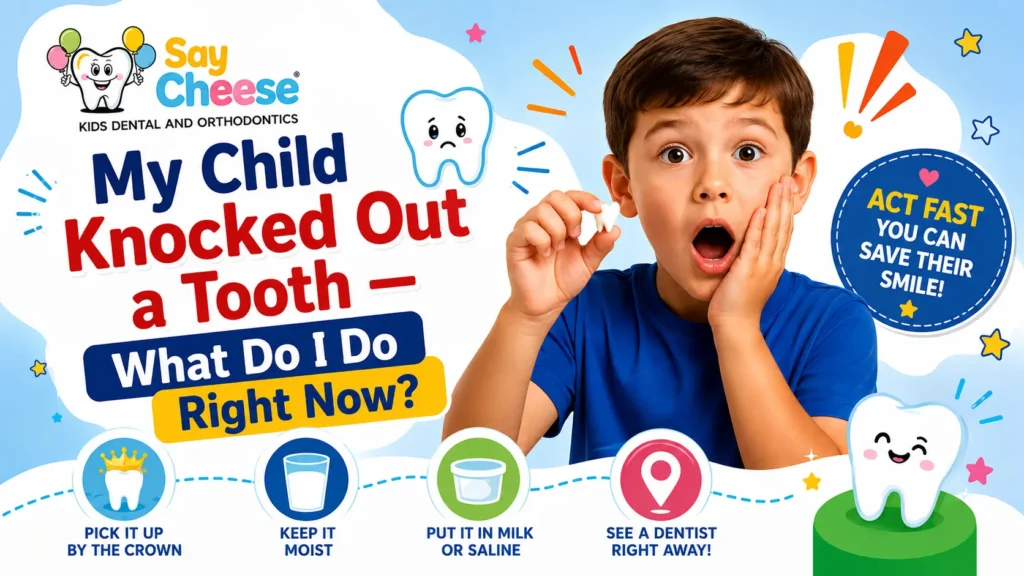
- Find the tooth and pick it up by the crown. The crown is the white chewing part. Never touch the root — the cells on its surface are what allow it to reattach.
- Do not scrub it. If it is visibly dirty, rinse for no more than ten seconds in milk, saline or the child’s own saliva. Never use tap water, soap, or a cloth.
- Put it back if you can. Gently push it into the socket the right way round, then have your child bite softly on a clean cloth to hold it in place. It will feel alarming to do — do it anyway, it is the single best thing for the tooth.
- If you cannot reimplant it, store it correctly. Cold milk is the best readily available option. A tooth preservation solution is better if you have one. Saliva works at a push — have the child hold it in their cheek if they are old enough not to swallow it. Never store it in water.
- Control any bleeding. Clean gauze or a cloth, firm pressure for ten minutes.
- Call the dentist immediately and say a permanent tooth has been knocked out. That phrase gets you seen straight away.
Why Milk and Not Water
This is the part almost everyone gets wrong. Plain water destroys the root cells through osmosis within minutes — the cells swell and burst. Milk closely matches the body’s own fluid balance and keeps those cells alive far longer, which is what makes reattachment possible.
If there is no milk, saliva is a distant second. Water is worse than nothing.
When to Go to an Emergency Room Instead
A knocked-out tooth on its own is a dental problem. Go to an emergency room, not a dental office, if any of these apply:
- Loss of consciousness, even briefly, or confusion and vomiting after the injury
- Bleeding that will not stop after ten minutes of firm pressure
- A suspected broken jaw, or the bite suddenly does not meet properly
- Deep facial cuts that may need stitches
- Difficulty breathing or swallowing
Head injury takes priority over the tooth. The tooth can be dealt with afterwards.
What Happens at the Appointment
For a reimplanted permanent tooth, we check the position, take a digital X-ray to confirm it is seated correctly and check for root fracture, then splint it to the neighbouring teeth for one to two weeks. Root canal treatment is often needed later, usually within a couple of weeks.
For a baby tooth, there is no reimplantation. We check the socket, confirm no fragments remain, and assess the permanent tooth developing above. If the tooth was lost well before it was due, a space maintainer may be recommended to stop the neighbouring teeth drifting into the gap.
Other Dental Injuries
Chipped or broken tooth
Save any fragments in milk — they can sometimes be bonded back on. Rinse the mouth with warm water and use a cold compress on the outside of the cheek. See emergency dental care.
Loosened but not knocked out
Leave it alone. Do not wiggle it. Soft foods only, and call us — a loosened tooth often stabilises on its own but needs checking for root damage.
Tooth pushed up into the gum
Common in younger children. Do not try to pull it down. This needs assessment, as the position of the permanent tooth above may be affected.
Preventing the Next One
Most dental injuries in children happen during sport or falls. A properly fitted mouthguard prevents the majority of them, and children whose upper front teeth protrude noticeably are considerably more likely to be injured — which is one of the genuine clinical reasons for an early orthodontic evaluation around age seven.
If your child wears braces, a mouthguard designed to fit over brackets is essential. A standard boil-and-bite will not seat correctly.
Common Questions
How long do I have to save a knocked-out permanent tooth?
Reimplant within 30 minutes if at all possible. Between 30 and 60 minutes the chances drop but are still reasonable if the tooth was stored in milk. After about an hour dry, success becomes unlikely.
Should I put a knocked-out baby tooth back in?
No. Reimplanting a baby tooth risks damaging the permanent tooth developing above it. Keep the tooth, control the bleeding, and call the dentist.
Can I store the tooth in water?
No. Plain water destroys the root surface cells within minutes. Milk is the best readily available option, then saliva. Never water.
What if the tooth is dirty?
Rinse it briefly — ten seconds at most — in milk or saline. Do not scrub, do not use soap, and do not dry it with a cloth.
My child is in pain. What can I give them?
Age-appropriate children’s paracetamol or ibuprofen, following the label. A cold compress on the outside of the cheek helps with swelling. Never place aspirin directly against the gum.
Will the tooth survive?
It depends on time out of the socket, how it was stored, and the child’s age. Teeth reimplanted within 30 minutes have a good outlook. We will give you an honest assessment at the visit rather than a promise.
Do you see emergencies the same day?
Yes, we keep room in the schedule. Call (909) 479-6030. We see families from Chino, Chino Hills, Ontario, Eastvale, Pomona and Montclair.
What if it happens at the weekend?
We are open Monday to Thursday 8:00 AM to 5:00 PM and Friday until 2:00 PM. Outside those hours, a knocked-out permanent tooth should be treated as urgent — store it in milk and seek an emergency dental service or hospital emergency department.
Final Thoughts
Almost every parent freezes for a moment when this happens, which is understandable and also the thing that costs the tooth. Two decisions matter: pick it up by the crown, and get it into milk or back in the socket fast. Everything after that is our job.
Keep our number somewhere findable — (909) 479-6030. Or request an appointment online for anything that is not urgent.
