Medically reviewed by Dr. Joshua Kohan, DMD — pediatric dentist, Say Cheese Kids Dental & Orthodontics, Chino, CA
Quick Answer
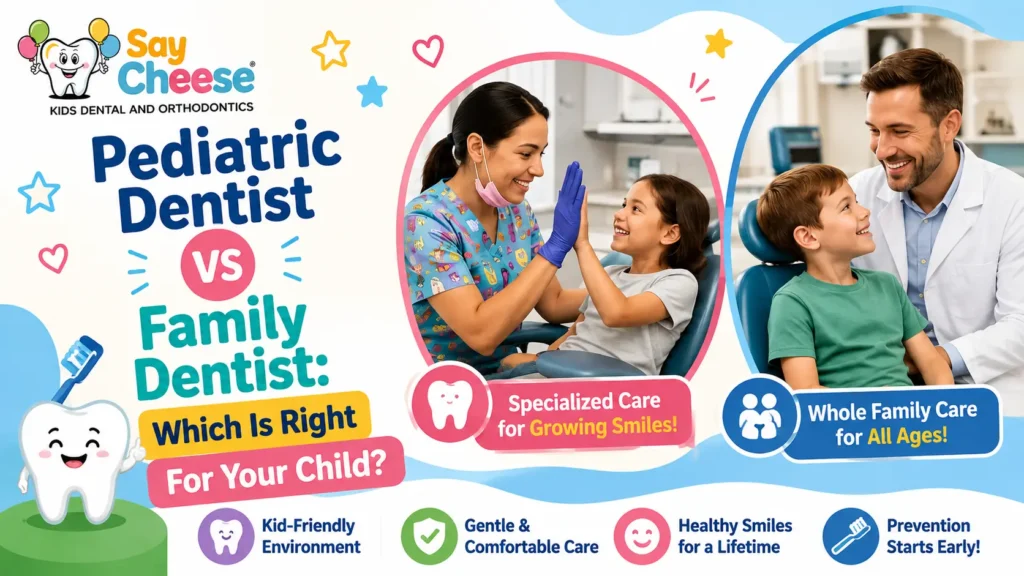
A pediatric dentist completes two to three years of additional residency after dental school, focused entirely on treating children. A family dentist treats all ages with a general dental degree. For most healthy school-age children, either works well. A pediatric dentist matters most for children under three, anxious children, those with special healthcare needs, and cases needing sedation or extensive treatment.
The Actual Difference in Training
Both are fully qualified dentists. Both complete four years of dental school. The difference comes after that.
A pediatric dentist completes an accredited residency of two to three additional years, working exclusively with children. That training covers child behaviour management, growth and development of the jaw and teeth, treating patients with special healthcare needs, sedation for young children, and managing dental trauma in developing teeth.
A family or general dentist may be excellent with children, and many are — but their training covers the full population rather than specialising in one part of it.
How They Compare
- Training — pediatric: dental degree plus 2–3 year residency in children’s dentistry. Family: dental degree, treating all ages.
- Patients seen — pediatric: infants through late teens only. Family: all ages, from young children to older adults.
- Equipment — pediatric: smaller instruments, child-sized chairs, an environment built around children. Family: adult-scale equipment, adapted where needed.
- Behaviour management — pediatric: formal training in helping anxious or uncooperative children. Family: experience-based, varies by practice.
- Special healthcare needs — pediatric: part of accredited residency training. Family: varies considerably.
- Sedation for young children — pediatric: specific training in pediatric sedation. Family: often refers out.
- Growth and development — pediatric: trained to monitor jaw growth and eruption, and to time orthodontic referral. Family: general monitoring.
When a Family Dentist Is Perfectly Fine
Plenty of children do well at a family practice, and there are real advantages to it.
- Your child is school-age, healthy, and comfortable at the dentist
- The whole family can be seen in one place on the same trip
- You have an established relationship and your dentist is good with your child
- Treatment needed is routine — exams, cleanings, the occasional filling
Convenience matters. A family that actually attends appointments at a general practice is better off than one that skips them because the pediatric office is a longer drive.
When a Pediatric Dentist Genuinely Matters
Very young children
The recommendation is a first dental visit by age one. Examining an eighteen-month-old is a different skill from examining an adult — it often happens knee-to-knee with the parent, and takes patience rather than technique. See our approach to toddler dental care.
Anxious or fearful children
If a previous visit went badly, or your child becomes distressed at the idea of the dentist, behaviour management training makes a real difference. Comfort-focused options including nitrous oxide are available where clinically appropriate.
Children with special healthcare needs
Sensory sensitivities, developmental differences, or medical conditions affecting dental care are all covered in pediatric residency training. See special needs dentistry.
Extensive treatment needed
Multiple fillings, crowns, pulp therapy or extractions in a young child require both technical skill and the ability to keep a child calm through a long appointment.
Bite and growth concerns
Knowing when to refer for orthodontic evaluation — and when to simply monitor — is part of pediatric training. Most children evaluated at age seven need nothing but watching.
Does It Cost More?
Not usually. Pediatric practices bill the same procedure codes as general dentists, and most take the same insurance. We accept Medi-Cal (Denti-Cal) and most major PPO plans — see our insurance page. Cost is rarely the deciding factor between the two.
At What Age Should a Child Move to an Adult Dentist?
Most pediatric practices see patients through the late teens, often until eighteen and sometimes beyond if orthodontic treatment is still finishing. There is no fixed cut-off. A reasonable point to transition is once a teenager has all their permanent teeth, has finished orthodontics, and is comfortable managing appointments independently.
Common Questions
Is a pediatric dentist better than a family dentist?
Not better — differently trained. For a healthy, cooperative school-age child, a good family dentist provides excellent care. For very young children, anxious children, those with special needs, or complex treatment, the additional training matters.
How much extra training does a pediatric dentist have?
Two to three years of accredited residency after completing the four-year dental degree, focused entirely on treating children and adolescents.
At what age should my child first see a dentist?
By age one, or within six months of the first tooth appearing, according to the American Academy of Pediatric Dentistry.
Can a family dentist treat my toddler?
Many will. The question worth asking is how many children under three they see each week. Experience with that age group matters more than the title on the door.
Do pediatric dentists do braces?
Some coordinate orthodontic care, others refer to an orthodontist. At our practice, orthodontic treatment is provided in coordination with our partner orthodontists, so children can stay with the same team.
What should I ask when choosing?
How many young children do you see? What happens if my child will not cooperate? What are your options for an anxious child? Do you accept our insurance? The answers tell you more than credentials alone.
Final Thoughts
The honest answer is that the right choice depends on your child rather than on which type of practice is objectively superior. A confident nine-year-old needing a checkup will do fine almost anywhere. A frightened three-year-old with several cavities is a different situation entirely.
If you are unsure, call and ask about your specific child. We are happy to say when a family dentist would serve you just as well — (909) 479-6030, or request an appointment.
