Medically reviewed by Dr. Joshua Kohan, DMD — kids dentist, Say Cheese Kids Dental & Orthodontics, Chino, CA
Quick Answer
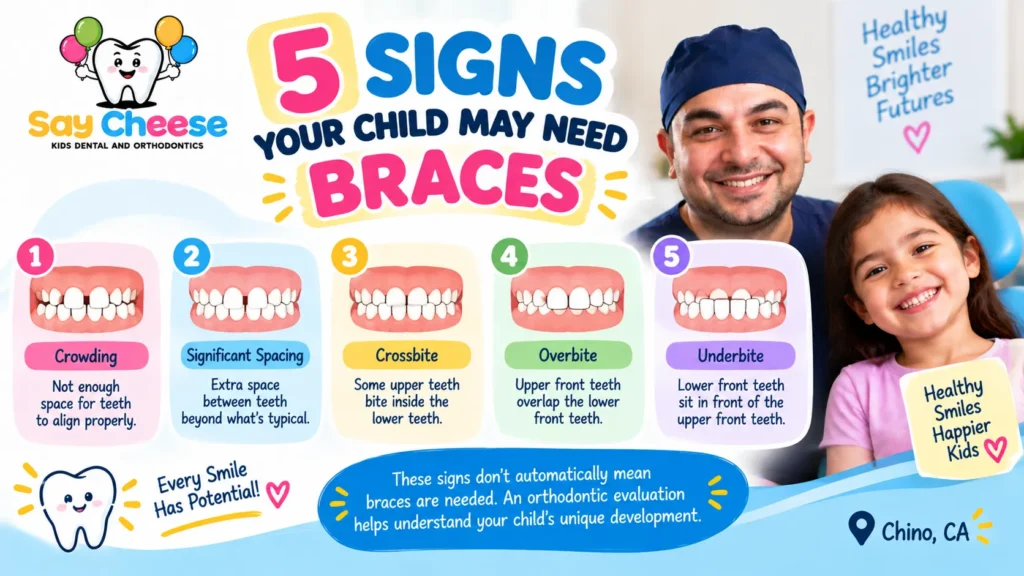
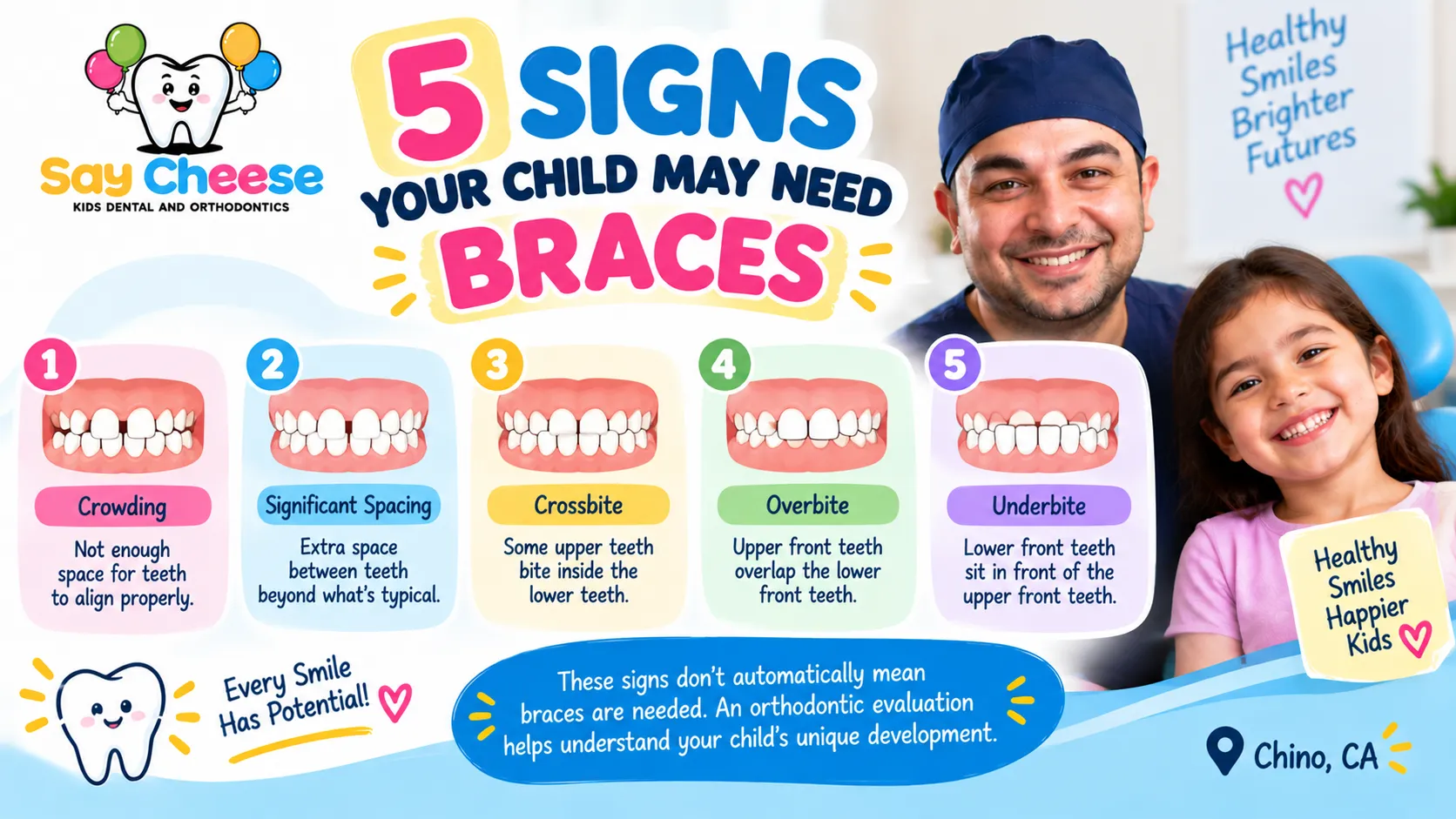
Five signs suggest an orthodontic evaluation is worthwhile: crowding, significant spacing, crossbite, overbite, and underbite. None of these automatically mean braces are needed. The American Association of Orthodontists recommends a first evaluation by age seven — and for most children that visit ends with monitoring rather than treatment.
The Five Signs
1. Crowding
Not enough room in the arch for teeth to line up, so they overlap, twist or sit out of line. Crowded teeth trap plaque where a brush cannot reach, which makes this a hygiene concern as much as an appearance one.
Mild crowding at seven often eases as the jaw widens. Significant crowding may benefit from creating space early.
2. Significant spacing
Gaps beyond what is typical for the stage of development. Some spacing in young children is entirely normal — it leaves room for larger permanent teeth. Persistent large gaps, or a tooth that never developed, are worth assessing.
3. Crossbite
Upper teeth biting inside the lower ones, at the front or on one side. This is the clearest reason to look early, because widening the upper jaw is far easier while a child is still growing. See crossbite treatment.
4. Overbite
Upper front teeth covering too much of the lower ones, or sitting well forward of them. Teeth that protrude noticeably are considerably more likely to be chipped or knocked in a fall — a genuine clinical reason to act rather than a cosmetic one.
5. Underbite
Lower front teeth closing ahead of the upper ones. Often related to how the jaws are growing relative to each other, so timing matters more here than in almost any other case.
Other Things Worth Mentioning at a Visit
- Difficulty chewing, or food regularly getting stuck
- Mouth breathing, or persistent snoring
- Thumb sucking or pacifier use continuing past about age four
- Jaw sounds, clicking, or shifting when biting together
- Baby teeth lost much earlier or later than expected
- Speech difficulties that a speech therapist links to tooth position
Why Age Seven
By seven, the first permanent molars and front teeth have usually arrived. That is enough for an orthodontist to see how the bite is developing and whether the jaws are growing in proportion — while there is still growth left to work with.
Being clear about what usually happens: most children evaluated at seven need nothing done. The visit establishes a baseline and identifies the minority for whom early treatment genuinely changes the outcome. See our guide to Phase I and Phase II orthodontics.
What Happens at an Evaluation
- An examination of the teeth, bite and jaw development
- Photographs and imaging where clinically indicated
- A clear explanation of what was found — including if nothing needs doing
- If treatment is warranted, the options, timing and cost before you commit
Consultations are free, so finding out where your child stands costs nothing.
Common Questions
Does my child need braces if they have one of these signs?
Not necessarily. These signs indicate an evaluation is worthwhile, not that treatment is needed. Many resolve as a child grows, and some are monitored for years before any decision.
Is seven too young for braces?
Usually yes for full braces. Age seven is for evaluation, not treatment. Comprehensive treatment normally begins between eleven and fourteen once permanent teeth are through.
What if we wait until all the permanent teeth are in?
For most children that is perfectly fine. The exception is a crossbite or a significant jaw discrepancy, where waiting can make correction harder or require surgery later.
Will my child need braces twice?
Most children need only one course of treatment in their teens. Two-phase treatment suits a minority where early intervention genuinely changes the eventual result.
Are clear aligners an option?
For suitable cases in older children and teens, yes — see clear aligners. Younger children still losing baby teeth do not have a stable set to plan against.
Does thumb sucking really affect the bite?
It can, if it continues past about age four while the jaw is still forming. Occasional sucking in a toddler is not a concern.
Does insurance cover orthodontic evaluation?
Our consultations are free regardless. Many PPO plans include an orthodontic benefit for treatment, usually as a lifetime maximum. Medi-Cal covers orthodontics only for severe cases meeting a scoring threshold.
My child’s teeth look fine. Is an evaluation still worth it?
Often yes, because jaw growth issues are not always visible from the front. It is also a useful baseline — if nothing needs doing, that is a genuinely useful answer.
Final Thoughts
These five signs are reasons to have a look, not reasons to worry. The most common outcome of an early evaluation is being told to wait and watch — and being told that honestly is worth the appointment.
Consultations are free. Call (909) 479-6030 or request an appointment.
