Medically reviewed by Dr. Joshua Kohan, DMD — kids dentist, Say Cheese Kids Dental & Orthodontics, Chino, CA
Quick Answer
Most children benefit from dental sealants. A sealant is a thin protective coating painted into the grooves of the back teeth — grooves narrower than a single toothbrush bristle, where the majority of childhood cavities begin. Application takes minutes, needs no drilling and no numbing, and sealants are usually placed soon after the permanent molars arrive around ages six and twelve.
Why the Back Teeth Are the Problem
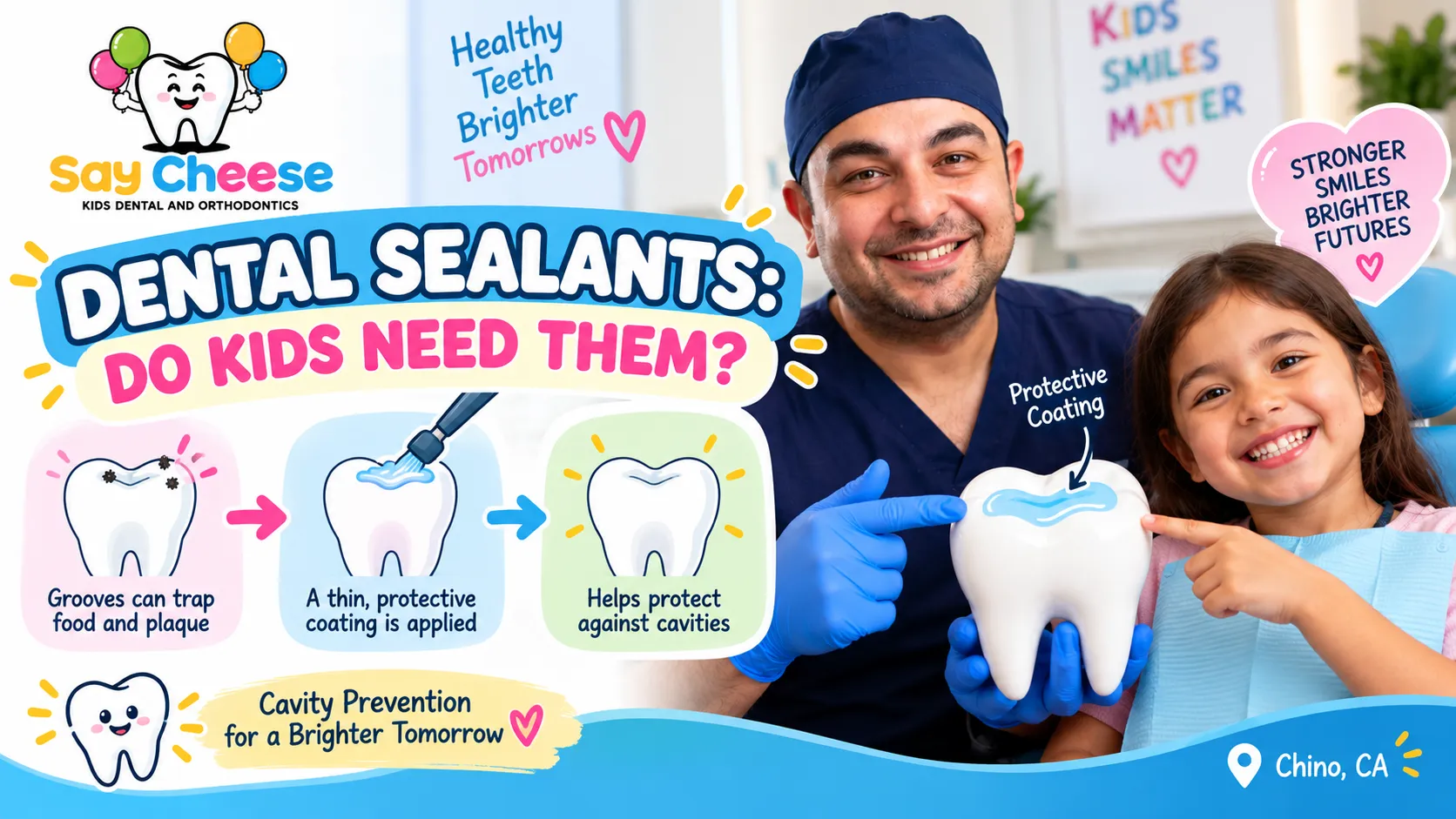
Look closely at a molar and the chewing surface is not flat. It is a landscape of narrow pits and fissures, and some of them are narrower than a toothbrush bristle.
No amount of careful brushing reaches the bottom of a groove a bristle cannot enter. Food and plaque settle there and stay. That is why most cavities in school-aged children start on chewing surfaces rather than anywhere else in the mouth.
A sealant fills those grooves with a smooth coating, so there is nowhere for debris to lodge and the brush can actually clean the surface.
What Happens at the Appointment
- The tooth is cleaned and dried
- A conditioning gel is applied briefly, then rinsed off — this helps the sealant bond
- The liquid sealant is painted on and flows into every groove
- A curing light sets it hard in a few seconds
- Your child bites together to check it feels level
The whole thing takes a few minutes per tooth. There is no drilling, no injection, and nothing to feel afterwards. Most children are surprised it is over so quickly.
When Sealants Are Placed
- Around age 6 — the first permanent molars arrive at the very back
- Around age 12 — the second permanent molars come through
- Premolars — sometimes sealed too, depending on groove depth and cavity risk
- Baby molars — occasionally sealed if the grooves are deep and risk is high
Timing matters: the tooth needs to be erupted enough to keep dry during placement. Too early and the sealant will not bond properly.
How Long They Last
Often several years. Sealants wear gradually with chewing rather than failing suddenly, which is why we check them at every routine exam and top up or replace any that have worn or chipped. Replacing one is quick.
What Sealants Do Not Do
Worth being clear about the limits. A sealant covers the chewing surface only. It does nothing for:
- The sides of teeth
- The areas between teeth that touch — where flossing matters
- The gumline
So brushing, flossing and fluoride still do their part. Sealants close one specific gap that brushing genuinely cannot reach — see preventive dentistry for the full picture.
Common Questions
Do sealants hurt?
No. Nothing is drilled and no injection is needed. The tooth is cleaned, a gel is applied and rinsed, and the sealant is painted on and set with a light.
Which teeth get sealed?
Usually the permanent molars, and sometimes premolars. Front teeth are not sealed because they do not have deep grooves.
Can sealants fall off?
Occasionally, most often from very hard or sticky foods. It is not painful and is usually spotted at a routine checkup. Replacing one takes minutes.
Are sealants safe?
Yes. They are widely recommended by children’s dental organisations. Some contain trace BPA-related compounds, with any brief exposure occurring in the minutes after placement — well below levels considered harmful. Wiping the tooth after curing reduces it further, which is standard practice.
Does insurance or Medi-Cal cover sealants?
Most PPO plans and Medi-Cal (Denti-Cal) cover sealants on permanent molars for children, often with age limits. We verify coverage beforehand — see what care costs with Medi-Cal.
My child already has a cavity in that tooth. Can it still be sealed?
If decay is already present, the tooth needs treating rather than sealing. Sealing over active decay traps it. Dr. Kohan checks each tooth before placing anything.
How do sealants compare with fluoride?
They do different jobs. Fluoride strengthens enamel across the whole tooth. Sealants physically block the grooves fluoride protects least well. Most children benefit from both.
Are sealants only for children?
They are most valuable soon after permanent molars erupt, but adults with deep unrestored grooves can benefit too.
Final Thoughts
Sealants are among the least invasive things in dentistry — no drill, no needle, a few minutes per tooth — and they protect the exact surfaces where most childhood cavities start. For most children they are straightforwardly worth doing.
Ask at your next visit whether your child’s molars are ready, or call (909) 479-6030. See dental sealants for more detail.
