Medically reviewed by Dr. Joshua Kohan, DMD — pediatric dentist, Say Cheese Kids Dental & Orthodontics, Chino, CA
Quick Answer
Children get cavities more easily because baby tooth enamel is thinner than adult enamel, their back teeth have deep grooves a toothbrush cannot reach, and they tend to snack frequently. It is not sugar alone — it is how often sugar reaches the teeth. Each exposure starts an acid attack lasting around 20 minutes, so six small snacks do more damage than one dessert.
How a Cavity Actually Forms
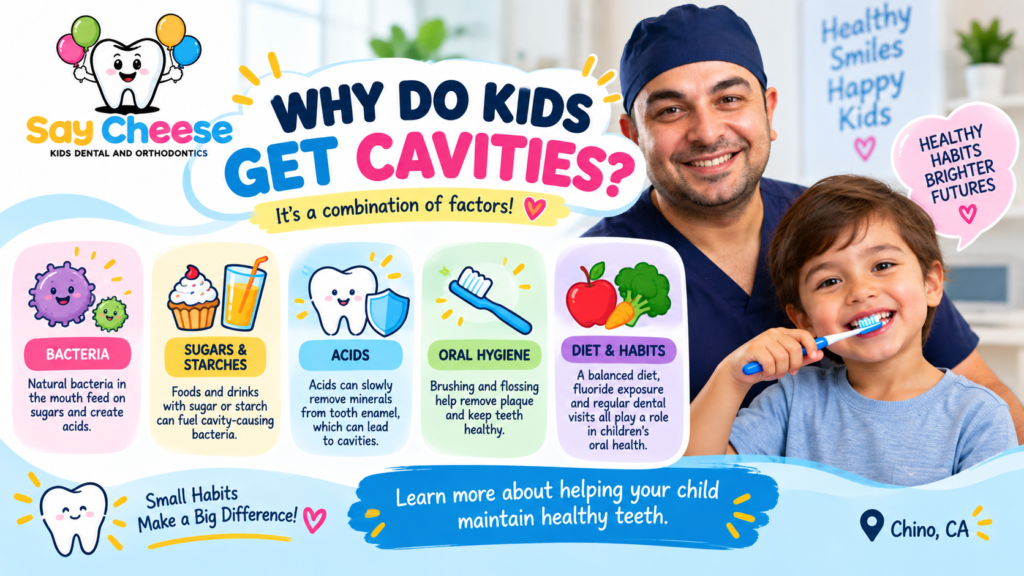
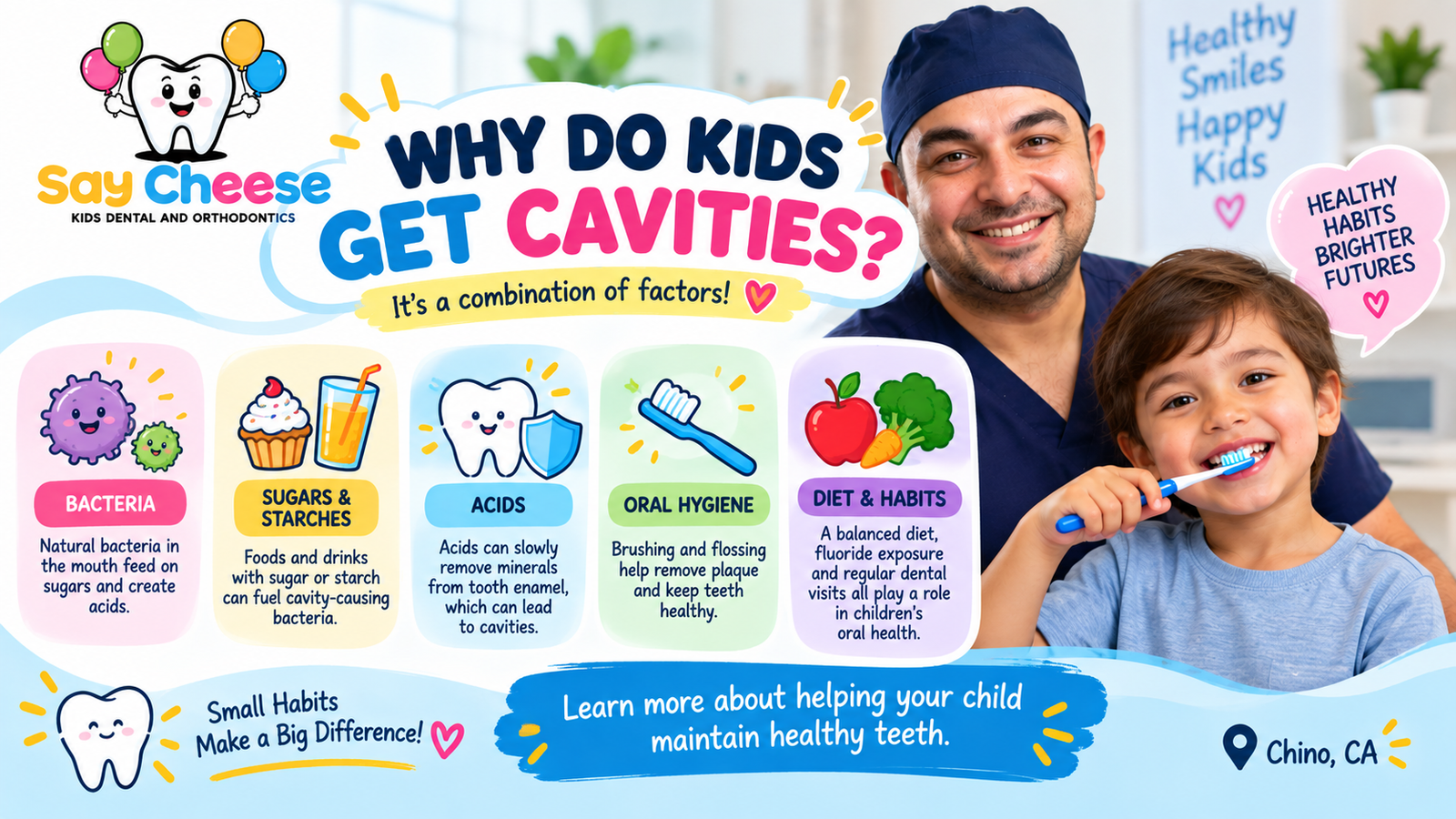
Cavities are not caused by sugar directly. They are caused by acid, and the sequence runs like this:
- Bacteria live naturally in every mouth — nothing has gone wrong here
- Sugars and starches arrive from food and drink and feed those bacteria
- Acid is produced as a by-product, and it dissolves minerals out of the enamel
- Saliva repairs the damage between meals, replacing lost minerals
- A cavity forms when acid attacks come faster than saliva can repair
That last point is the whole story. Teeth are constantly losing and regaining minerals. A cavity is simply the balance tipping the wrong way for long enough.
Why Children Are More Vulnerable Than Adults
Thinner enamel
Baby tooth enamel is roughly half the thickness of adult enamel. Decay that would take years to reach the nerve in an adult tooth can do so in months in a child.
Deep grooves in the back teeth
The chewing surface of a molar has grooves narrower than a single toothbrush bristle. No amount of good brushing reaches the bottom of them, which is exactly why most childhood cavities start there. Sealants exist to fill those grooves.
Snacking frequency
This is the one parents underestimate. A juice box sipped over an hour keeps the mouth acidic for that entire hour. The same juice drunk in five minutes causes one short attack. It is frequency, not quantity.
Brushing skill
Children lack the manual dexterity to brush thoroughly until around age seven or eight. Until then, an adult needs to brush or at least finish the job.
The Habits That Cause the Most Damage
- Bedtime bottles of milk or juice — saliva flow drops during sleep, so sugar sits against the teeth for hours
- Constant sipping of juice, squash or sports drinks through the day
- Sticky sweets — gummies and dried fruit cling to grooves far longer than chocolate does
- Crackers and crisps — starches break down into sugars and pack into grooves
- Grazing — the mouth never gets an acid-free stretch to repair
What Actually Prevents Them
- Brush twice daily with fluoride toothpaste and supervise until age seven or eight
- Group sweets with meals rather than spreading them across the day
- Water between meals — it rinses and does not feed bacteria
- Floss once any two teeth touch, since decay between teeth is invisible until it is large
- Sealants on permanent molars and fluoride as part of preventive care
- Six-monthly exams so decay is caught while it is small
Common Questions
Why does my child get cavities when we brush every day?
Brushing cannot reach the grooves of the back teeth or between teeth that touch. Frequency of snacking also matters more than brushing alone. Sealants and flossing close both gaps.
Is it my fault my child has cavities?
Almost never. Cavity risk is influenced by enamel structure, saliva composition, bacteria inherited early in life, and medical conditions — not just diet and brushing. Some children are simply more susceptible.
Does sugar cause cavities on its own?
No. Bacteria convert sugars and starches into acid, and it is the acid that dissolves enamel. How often sugar arrives matters far more than the total amount.
Are cavities in baby teeth serious?
Yes. Decay progresses faster through thinner enamel, and an infection can affect the permanent tooth developing beneath — see why baby teeth matter.
Can a cavity heal on its own?
Very early enamel damage can remineralise with fluoride before a hole forms. Once the surface has broken, it needs treatment — though silver diamine fluoride can sometimes arrest it without drilling.
How do I know if my child has a cavity?
Often you cannot. Early decay causes no pain and may be invisible between teeth. That is what routine exams and, where indicated, X-rays are for.
Does fluoride toothpaste really help?
Yes, substantially. It helps enamel rebuild after acid attacks. Use a rice-grain smear under age three and a pea-sized amount after.
Are some children just more prone to cavities?
Yes. Enamel quality, saliva flow, bacteria acquired in infancy and certain medications all affect risk. We assess individual risk rather than applying one schedule to everyone.
Final Thoughts
If your child has cavities despite reasonable brushing, the answer is usually in snacking frequency or in grooves that a brush cannot reach — not in effort. Both are fixable.
Call (909) 479-6030 or request an appointment and we will work out what is driving it for your child specifically.
